Showing posts with label early manga days. Show all posts

Tuesday, July 15, 2025

EARLY MANGA DAYS: RAW #7 (1985)


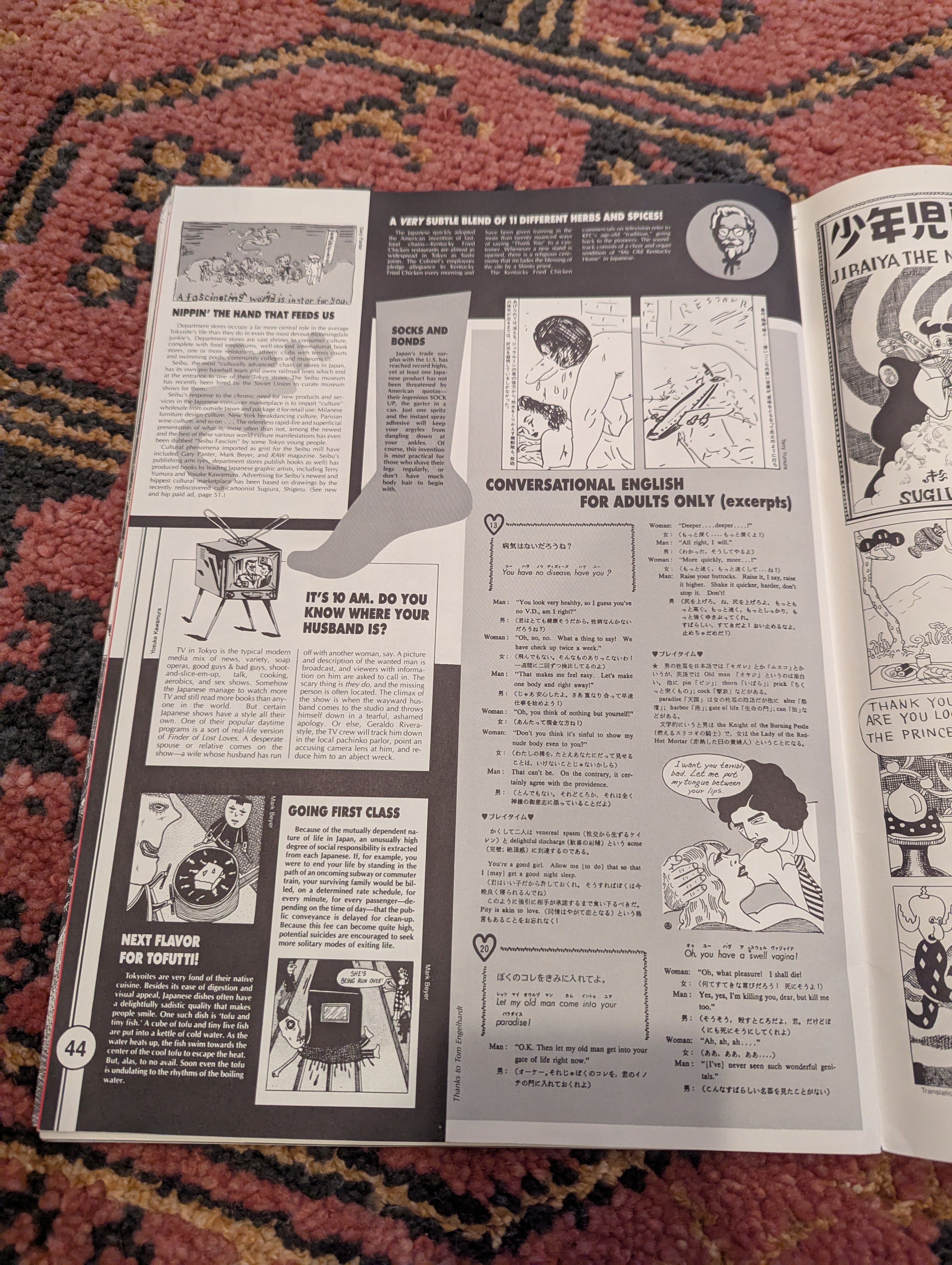
Managed to finally snag a copy of RAW #7 (May 1985), known as the “torn” issue with a hand-torn corner - but relevant here for the “TOKYO RAW” section. This section always loomed large in my mental imagination, as sorta THE moment of convergence between New York 80s indie (Beyer, Burns, Swart) intersecting with the core GARO team. Seeing it in person, it’s both striking in how contemporary and plugged into a shared aesthetic and moment it seems, while also having so much weird racialized anxiety throughout it. 


While I see a straight line from this RAW issue with musings by Art Spiegelman to the essays and columns of Carl Gustav Horn and Kit Fox in Pulp (and the early manga musings of Eric Nakamura in Giant Robot), the Japan imagined in Raw #7 is held and viewed at arm’s length (or further) while the California Millennial vantage point in Viz’s PULP sees the indie manga contemporaries as adjacent, brothers-in-arms of a shared aesthetic (and politic?).


The main section is 12 pages and features King Terry, Yosuke Kawamura, and Sugiura Shigeru - as well as a special 12 page Tsuge Yoshiharu color ashcan of “Red Flowers.” The typesetting in this latter insert is impressive and extremely contemporary (done by Phil Felix) with a translation by Yoshiko Kasuga and Paul Karasik. This insert is the standout piece of the book - though now we are blessed with the 5 volume (and growing) anthology of Tsuge’s work thanks to D&Q and Ryan Holmberg.


The tabloid size of RAW #7 is the main arresting feature, giving King Terry’s strips a reverence that is deserved and playful. That same wealth of space in the introduction section is a curse - leaving lots of room for edgelord-esque columns and “Gung Ho” stereotypes that would have been wild even back in1985. As an object of history for the early days of manga, it’s a fascinating snapshot of how Art and the New York scene of art comix was observing and monitoring a slice of Japanese cartoonists from afar.


Thursday, March 07, 2013

Toren Smith, RIP (1960 - 2013)

I learned the sad news today that Toren Smith has passed away at the young age of 52.


Toren was a fascinating guy, the founder of Studio Proteus and arguably one of the most important figures in the entire history of the English-language manga industry. Please take a few minutes to read this personal tribute from his friend Jonathen Clements - it paints a picture of a unique and exciting life, and fills in details about the earliest days of manga and anime fandom in America. The instrumental role Toren had in American comics history (alongside folks like Same Hat heroes Fred Schodt, Fred Patton, and others) can't be overstated.

If you were a manga/anime nerd in the '90s like me, and enjoyed any of the following Studio Proteus-powered titles, please remember Toren Smith today and keep his family and friends in your thoughts:


Tuesday, October 23, 2012

MORE MANGA PAGES FROM CTJ

Here's a quick follow-up for folks that haven't dug into my overview post on the great Concerned Theatre Japan, which ran from 1969 to 1973.

I separated out the first five pages from each of the three manga in that issue, arguably the first manga ever translated into English! If you dig these teasers, you can download the entire issue below as a convenient PDF:

Sakura Illustrated ("Sakura Gaho") by Akasegawa Genpei [1971]


Red Eye ("Akame") by Shirato Sampei [1969]


The Stopcock ("Nejishiki") by Tsuge Yoshiharu [1969]


[CLICK HERE TO DOWNLOAD THE COMPLETE PDF]

Tuesday, October 16, 2012

MORE GENPEI AKASEGAWA ART FROM 1971

Hot on the heels of the return post about Concernted Theatre Japan's special manga issue, I'm posting more images of work by Genpei Akasegawa from 1971.

These images come from the pages of 「黒い手帖 ブラックユーモア」 ("kuro no techo burakku yuumoa" - Black Memo/Black Humor), from May 1971. Doing a little digging, I found an interesting post (in Japanese) about the publication on the Komiyama Shoten bookstore blog.  Thanks for the scans go to the fantastic Will of the great 50 WATTS blog.


You can find more about Akasegawa's work and his "Hyperart" movement/experiment with found objects in this Amazon listing for his Hyperart: Thomasson book.

Sunday, October 14, 2012

INCREDIBLE FIRST-EVER MANGA TRANSLATED IN 1971

(This post is part of a series I've tagged as "early manga days", chronicling rare/weird gems from the beginning of manga's now 30+ year history of publication in English. Click all images for big versions!)

A new renewal for Same Hat? I've been meaning to write for a few months now, but I found myself continuing to delay compiling all my shreds of random thoughts together until I could find time to attack it properly. I think you'll find the materials discussed in this post live up to the hype, and I'm hoping this will lead to a few more interesting posts and interviews being unearthed in the near future.


Concerned Theatre Journal (CTJ) debuted in October 1969, and was conceived of, coordinated, and translated by David. G. Goodman. In 1971, CTJ released the first issue of its second volume as a double-sized "cartoon special". The 116 page issue featured the following three stories:
  • Sakura Illustrated ("Sakura Gaho") by Akasegawa Genpei   [1971]
  • Red Eye ("Akame") by Shirato Sampei [1969]
  • The Stopcock ("Nejishiki") by Tsuge Yoshiharu [1969]


As nerds who've seen our ramshackle "Early Manga Days: Chronology" post, this predates the publication of translation of Barefoot Gen by seven years, and the short story "The Bushi" (written by Satoshi Hirota and art by Masaichi Mukaide) appearing in Star*Reach #7. Between 1969 and 1973, nine issues were released by Goodman and his collaborators totaling "nearly thirteen hundred pages of translated plays, criticism, and scholarship." It's an amazing treasure trove of politically-active, internationally-minded theater criticism and translations from an exciting time in Japanese history.

From the first "Special Introductory Issue":

A great overview of the entire life of Concerned Theatre Japan can be found in Virtual CTJ, an essay which was written in early 2005. In this retrospective, Prof. Goodman explained their perspective:
The mentality was different, too. Much of what is said today about Japan’s historical amnesia, its failure to confront the legacy of the Asia-Pacific War, was not true of CTJ. Our contributors were mostly in their late twenties or very early thirties; and, like the first postwar generation in other countries, they were actively interrogating their parents’ generation and the aftermath of the war. The plays and articles in CTJ continue to be trenchant critiques of Japan’s wartime behavior.

Goodman was a senior at Yale in fall of 1968, and writing about / documenting new theatre groups visiting America at the time. He explains the genesis of an English language magazine:
I learned through our correspondence of the ambitious program the June Theatre was planning in a new alliance to be called Theatre Center 68/69. The program included a plan to publish a magazine, and I proposed that an English-language sister publication be issued as well. What was needed, I argued, was a vehicle that would allow Japanese artists, writers, and scholars to participate fully in global intellectual discourse that would empower them to engage their peers around the world and be engaged by them. Tsuno responded that it was an ambitious idea, that no one knew the first thing about publishing such a magazine, and that no money was available to support it, but if I was prepared to edit it, I was welcome to do so. I decided to go ahead.

In addition to the original essays and translations of contemporary plays (and the manga issue!), TCJ features rad graphic design and interesting ads from shops and brands eager to align to themselves with the dramatic, visual, and envelope-pushing theater productions of the time:


For (much) more on the visual culture of the theater, you must check out another book edited/curated by Prof. Goodman: "ANGURA: Posters of the Japanese Avant-Garde," a book documenting the posters by Tadanori Yokoo, Hirano Koga, Shinohara Katsuyuki, and their contemporaries. 


Writing specifically about CTJ's manga special, Prof. Goodman said: 
In the late 1960s and early 1970s, Japanese popular culture was not yet a global phenomenon. No one had ever heard of manga, much less video games and animé. The graphics we published by Akasegawa Genpei, Tsuge Yoshiharu, and Shirato Sampei were, as far as I know, the first manga ever to appear in English.
I'm least familiar with Genpei Akasegawa's work, but his satirical newspaper opens up the book with a bang and firmly ties the contents that follow to the 1969 Tokyo University Protests and the aftermath of their failures and co-option. 

Next up in the issue is "Red Eyes" by Shirato Sanpei, a powerful and intense period piece by one of the originators of gekiga. Sanpei is best known, in Japan and English-speaking readerships, for creating The Legend of Kamui. The manga "Red Eyes" was later adapted by Saitô Ren, and published in Concerned Theatre Japan.


Finally, on that last but not least tip, we have a translation of "Nejishiki" by Yoshiharu Tsuge -- named here as "The Stopcock"(!).  This would appear 32 years later as "Screw-Style" in The Comics Journal #250. It seems silly to add much commentary to such an important and pioneering work, but it is an obvious must-read for any Same Hat fan of alternative manga-- the linchpin/shared ancestor of a lot of our favorite manga!


[ --> CLICK HERE TO DOWNLOAD THE COMPLETE PDF <-- ]
PDF hosted via the University of Michigan "Center for Japanese Studies Publications" page.

Please enjoy this incredible collection of early manga. Friend of Same Hat and manga-in-America pioneer Fred Schodt sent this thoughts in response to seeing the Concerned Theatre Japan's manga issue:
It definitely predates Gen by nearly 10 years. Whether it's the first manga translated or not, I'm not sure, because it depends on how you define manga. Short manga were being translated in Tokyo Puck at the beginning of the 20th Century, and even in Maru Maru Chinbun at the end of the 19th Century. But I've never seen these pseudo story-manga done so early. And they're all great favorites of mine. In fact, it reminded me how powerful manga were in that period. More powerful than most today, I venture, simply because of the political intensity of the period, and the radical-ness of using manga to transmit such sophisticated ideas.

[Many thanks to Paul for initially tipping me off to the existence of these online archives. Professor Goodman now teaches at University of Illinois at Urbana-Champaign. I'm contacting him for an interview in the coming weeks.]